
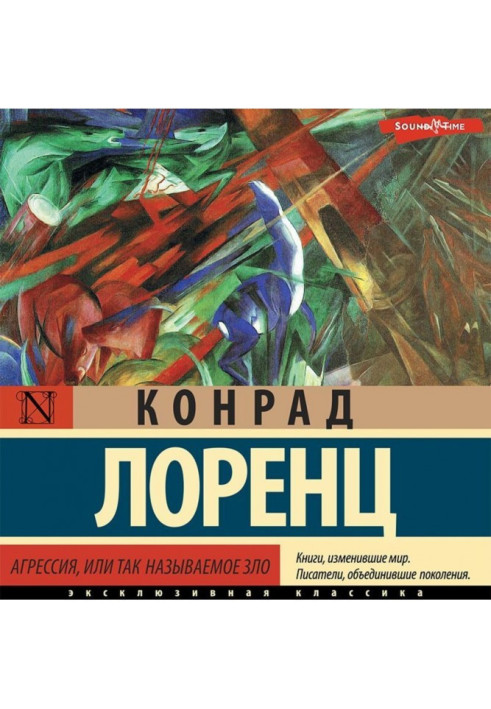
Book Aggression, or So-Called Evil
Listen to an excerptListen to an excerpt
book type

Book Aggression, or So-Called Evil

LR161447
Russian
In stock
4  
158 UAH
143 UAH - 10%

Did you know that deep personal attachment can only occur in species where there is a high level of aggression?

Konrad Lorenz is an outstanding animal psychologist, winner of the Nobel Prize in Physiology or Medicine.

< p>“Aggression, or the So-Called Evil” is one of his most famous works, in which he considers aggression on the example of a variety of biological species - aquarium fish, rats, geese, wolves and, finally, people and comes to a paradoxical conclusion: a deep personal attachment occurs only in those communities where there is a high level of aggression. Where there is no aggression, there is no strong friendship and true love. So is it possible to consider aggression as evil, and the suppression of aggression as a blessing? And will humanity be able to develop in the event of a complete rejection of aggression against their own kind?..

Copyright

dtv Verlagsgesellschaft mbH Co. KG, Munich/Germany, 1983

Translation. A. Fedorov, heirs, 2017

Russian edition AST Publishers, 2020

For Apple devices, a computer with iTunes installed is required to play the file correctly.

Questions and answers

What is the book Aggression, or So-Called Evil about in short?

"Aggression, or So-Called Evil" by Konrad Lorenz explores the complex relationship between aggression and personal attachment across various species. The author argues that high levels of aggression are necessary for forming deep personal bonds, challenging conventional views on aggression as purely negative. This thought-provoking work invites readers to reconsider the role of aggression in social dynamics.

What is the main idea of the book Aggression, or So-Called Evil?

The main idea of "Aggression, or So-Called Evil" is that aggression is not inherently evil but rather a crucial component for developing strong social bonds. Lorenz presents evidence from various species, including humans, to illustrate that without aggression, true friendship and love may not exist. This perspective encourages readers to rethink societal attitudes toward aggression and its implications for human relationships.

Who should definitely read the book Aggression, or So-Called Evil?

This book is essential reading for anyone interested in psychology, sociology, or animal behavior. It appeals to scholars and laypeople alike who wish to understand the complexities of aggression and its role in forming relationships. Additionally, those exploring philosophical questions about morality and human nature will find Lorenz's insights particularly enlightening.

What books is the book Aggression, or So-Called Evil similar to?

"Aggression, or So-Called Evil" shares thematic similarities with works like "The Anatomy of Violence" by Adrian Raine and "The Social Animal" by Elliot Aronson. These books also delve into the psychological underpinnings of human behavior and social interactions. Readers interested in exploring the intersection of aggression and social bonding will find these titles compelling companions.
Name of the Author
Лоренц Конрад
Language
Russian
Age
16
Series
Philosophy - Neoclassic
ISBN
978-5-17-141858-8
Release date
1983

Reviews

Grade 


04/21/2025

Агрессия как основа привязанности

Книга Конрада Лоренца "Агрессия, или Так называемое зло" — это глубокое и провокационное исследование, которое заставляет задуматься о природе агрессии и её роли в жизни различных видов. Лоренц, используя примеры из мира животных, показывает, как агрессия может быть неотъемлемой частью формирования социальных связей. Его вывод о том, что высокая степень агрессии способствует возникновению глубокой личной привязанности, кажется парадоксальным, но при этом очень убедительным. Плюсы книги — это её научная основа, доступный язык и увлекательные примеры. Однако некоторые читатели могут найти стиль изложения несколько сухим, а аргументы — слишком односторонними. Тем не менее, работа Лоренца открывает новые горизонты в понимании человеческой природы и социальных взаимодействий. Это обязательное чтение для всех, кто интересуется психологией и биологией поведения.

Grade 


12/30/2023

Не відповідає очікуванням

Чесно кажучи, книга «Агресія, або Так зване зло» не відповідала моїм очікуванням. Хоча тема агресії та прихильності цікава, але спосіб подання матеріалу виявився для мене занадто складним та важким для сприйняття. Деякі розділи здавалися занадто теоретичними та важкими для розуміння. Хоча книга має свою цінність як джерело знань, вона не викликала у мене емоційного зворушення чи захоплення. Можливо, вона буде цікава для фахівців у галузі психології та зоології, але для широкого загалу може виявитися складною.

Grade 


08/14/2022

Неймовірно цікава книга, яка залишає слід у серці!

«Агресія, або Так зване зло» - це твір, який захоплює з перших сторінок і не відпускає до останньої. Конрад Лоренц вдало поєднав наукові дослідження з філософськими роздумами, розкриваючи перед читачем неймовірний світ агресії та прихильності. Книга допомагає краще зрозуміти природу людських відносин та власних емоцій, а також викликає багато дискусійних моментів. Це варто прочитати кожному, хто цікавиться психологією та повсякденними міжособистісними відносинами!

Grade 


06/08/2022

Абсолютно захоплююча книга, яка перевершує усі мої очікування!

«Агресія, або Так зване зло» - це шедевр, який залишив у мене незабутнє враження. Конрад Лоренц здійснив неймовірну подорож у світ агресії, розглядаючи її на прикладі різних біологічних видів. Його дослідження та висновки про взаємозв'язок агресії та особистої прихильності вразили мене до глибини душі. Ця книга викликає багато питань, змушує задуматися над природою людських стосунків та емоцій. Рекомендую цю книгу всім, хто цікавиться психологією, зоологією та філософією!
Write your review

Book Aggression, or So-Called Evil

Did you know that deep personal attachment can only occur in those species where there is a high level of aggression? Konrad Lorenz is an outstanding zoopsi...

Write your review

More books by this author

More books on this topic